The Best Cycle Syncing Apps in 2026: 9 Compared, Honestly
By the Phase team · · 11 min read
Short answer
There is no single best cycle syncing app, because these apps solve different problems. For lifting, Phase is the only one with a real strength logger underneath. For endurance athletes, Wild.AI. For perimenopause, Jennis. For guided classes by phase, Sync N. For tracking alone, Clue. Pick by what you actually train for, not by which app markets hardest.
Disclosure, before anything else: we make one of the apps on this list. Phase is ours. We have given it a single category — strength training — instead of the top spot overall, because it would be the wrong recommendation for someone who runs marathons or wants a yoga flow for their luteal phase. Every other winner below is a competitor, and we have tried to describe each one as its own team would.
Why most cycle syncing app lists are useless
Search this topic and you will find roundups of nine or ten “cycle syncing apps” where only one or two actually change your training. The rest are period trackers, meditation apps, mood journals and generic workout libraries, padded in to reach a round number. One widely shared 2025 roundup lists nine apps of which exactly one adapts training to your cycle; the other eight are trackers, mental-health tools and a meditation app.
That is not a comparison, it is a directory. So this page only includes apps that do at least one of two things: read your cycle and change what your training looks like, or track your cycle accurately enough to feed an app that does.
Read this before you install anything
The strong version of cycle syncing — lift heavy in your follicular phase, switch to pilates in your luteal phase, rest on your period — is not supported by the evidence. A systematic review and meta-analysis of 78 studies found only a trivial average performance difference between phases, and a 2025 study in The Journal of Physiology found no difference in muscle protein synthesis between the follicular and luteal phases.
What is well documented is symptom burden. In a survey of 1,086 athletes, 74% reported period pain and 78% reported premenstrual symptoms. Your maximal strength may be statistically unchanged while the session still feels twice as hard — and that gap is the real thing worth managing.
So the honest test for any app in this category is not “does it follow the phases?” but “does it help me keep training consistently through the weeks that feel bad?” We have written up the full evidence base, including the parts inconvenient for us, in does cycle syncing actually work.
The nine apps, compared
| App | Best for | Cycle-aware programming | Full strength log | Platform |
|---|---|---|---|---|
| Phase (ours) | Lifting and progressive overload | Yes — automatic, overridable | Yes — full logger, e1RM, PRs | iPhone + Apple Watch |
| Wild.AI | Endurance and multi-sport athletes | Yes — readiness guidance | Basic logging | iOS + Android |
| FitrWoman | Athletes wanting phase education | Suggestions, not a program | No | iOS + Android |
| Jennis | Perimenopause and general fitness | Yes — Cycle Mapping plans | No | iOS + Android |
| Fourmula | AI coaching on top of your log | AI advice | Workout logging | iOS + Android |
| Sync N | Guided classes by phase | Yes — phase-based plans | No | iOS |
| Drop It | Daily auto-regulation | Yes — cycle + biofeedback | Guided sessions | iOS |
| 28 | Beginners learning the phases | Guided phase content | No | iOS + Android |
| Clue | Accurate tracking to pair with a lifting app | No | No | iOS + Android |
Best for lifting — Phase (ours)
Every other app in this category treats strength training as one content category among many: a phase-appropriate workout video, a suggested intensity, a note to go easier this week. None of them is a tracker you would use to run a real progressive-overload programme.
Phase is a full lifting logger first — set logging, plate maths, rest timer, RPE, estimated 1RM and automatic PR detection — with cycle awareness layered on top. It reads your cycle from Apple Health, tags every session with the phase you were in, and shows your estimated 1RM chart coloured by phase so you can see your own pattern rather than a generic one. It adjusts suggested volume and RPE caps, but never blocks a session and lets you override every modifier.
It is also the only app here with a proper Apple Watch app, which matters because the other tools are largely phone-side content libraries with nothing to drive from your wrist.
Skip it if you want guided video classes, yoga or running plans. Phase does not have them and is not trying to.
Best for endurance and multi-sport athletes — Wild.AI
Wild.AI is the most established option for athletes whose training is primarily cardiovascular. It builds readiness and intensity guidance around your cycle, integrates with wearables, and extends to fuelling and recovery rather than stopping at workouts. The free tier covers phase tracking and basic intensity guidance; detailed programming and integrations sit behind a subscription.
If you are a runner, triathlete or cyclist who also lifts, this is the better hub — the strength logging is basic, but that is not why you would choose it.
Best for phase education — FitrWoman
FitrWoman comes out of Orreco's sports-science work and has the strongest educational layer in the category. It explains each phase, tells you which one you are in, and suggests how to adjust training to match. It is free with some paid features.
The important caveat: those are suggestions, not a programme. It will tell you what a phase typically means; it will not build or track your training block for you.
Best for perimenopause — Jennis
Built around Olympic heptathlete Jessica Ennis-Hill, Jennis is the only app here with a serious perimenopause offering alongside its menstrual programmes. Its Cycle Mapping feature tracks estrogen and progesterone across the month and adjusts workouts and nutrition guidance to the phase you are in.
If you are navigating perimenopause, this is a materially better fit than anything else on this list, including ours.
Best for guided classes — Sync N
Sync N delivers a personalised plan that adapts to each phase, with guided sessions spanning strength, pilates, sculpt, yoga, stretching and recovery. It explicitly accounts for irregular cycles, PCOS and endometriosis, which most competitors gloss over.
Choose it if you want to be told what to do and follow along. It is the opposite of a logger.
Best for daily auto-regulation — Drop It
Drop It adjusts intensity, volume, weight and rest based on both your cycle phase and daily biofeedback — how recovered you actually report feeling, not just where you are in the month. That second input is the interesting part, and it is closer to how good coaching works than a fixed phase calendar.
Best AI coaching layer — Fourmula
Fourmula pairs workout and symptom logging with an AI coach that learns your patterns over time and advises on training, recovery and consistency. Worth a look if you want conversational guidance rather than a structured programme.
Note that Fourmula appears as the lead recommendation in several prominent roundups of this category, in placements that read as sponsored. That does not make the app bad — it does mean you should discount those rankings.
Best for learning the phases — 28
28 is the gentlest on-ramp: guided phase-based content aimed at people who are new to the idea and want to understand their cycle before restructuring their training around it. Light on tracking, strong on explanation.
Best pure tracker to pair with a lifting app — Clue
Clue does not program training at all, and it is on this list for exactly that reason. It is the most scientifically careful period tracker available, it avoids vague wellness claims, and it writes to Apple Health — which means it can feed a training app that does the programming. Clue plus a real lifting tracker is a genuinely good setup.
How to choose in one minute
- You lift and care about your numbers going up — you need a real logger. Phase, or Clue plus a dedicated strength app.
- You run, ride or swim — Wild.AI.
- You are in perimenopause — Jennis.
- You want to press play and follow along — Sync N or 28.
- You just want accurate data and no advice — Clue.
- Your cycle is irregular, or you are on hormonal birth control — check how each app handles it before paying. Phase switches to standard progression on hormonal contraception rather than inventing phases; several apps here do not say what they do.
Three things to be sceptical of
Any app that promises better results from phase-based training.The evidence does not support it. Apps that help you train consistently and manage symptoms are making a claim that holds up; apps promising extra muscle from training the “right” phase are not.
Any app that tells you to skip training. Missing planned sessions every single month costs far more progress than any hormonal fluctuation does. Reduce load or volume on a bad day — do not delete the session.
Any app that will not tell you where your cycle data lives. This is among the most sensitive data you will ever put in an app. Ask whether it is stored on your device or on a server, whether there are accounts, and whether it is shared with advertisers. Phase keeps everything on your iPhone and in your own private iCloud, with no accounts, no ads and no analytics — and you should demand a specific answer from every other app here too.
The short version
The category is more crowded than it looks, but most of the crowding is period trackers wearing a fitness label. Only a handful of apps genuinely change your training, and they split cleanly by sport: Wild.AI for endurance, Jennis for perimenopause, Sync N and 28 for guided sessions, Clue for data, and Phase if the number on the bar is the thing you actually care about.
If you want the strength-training side in more depth, we compared the major lifting trackers — Strong, Hevy and the rest — in the best workout tracker for women.
Frequently asked
What is the best cycle syncing app?+
It depends what you train for. For lifting and progressive overload, Phase is the only option that combines a full strength logger with cycle-aware programming. For endurance and multi-sport athletes, Wild.AI is the strongest pick. For perimenopause, Jennis. For guided classes organised by phase, Sync N. There is no single best app because these tools are solving genuinely different problems.
Are cycle syncing apps based on real science?+
The tracking is real; the strong claims usually are not. A meta-analysis of 78 studies found only trivial average differences in exercise performance between cycle phases, and a 2025 study found no difference in muscle protein synthesis between the follicular and luteal phases. What is well documented is symptom burden — roughly 74% of athletes report period pain and 78% report premenstrual symptoms. Treat any app promising dramatically better results from phase-based training with scepticism.
Is there a free cycle syncing app?+
Several have free tiers. Wild.AI offers phase tracking plus basic intensity guidance for free, and FitrWoman is free with some paid features. Clue is free for cycle tracking, though it does not program training. Most apps put detailed programming and integrations behind a subscription, so check current pricing on each app's own listing before committing.
Do I need a separate period tracker as well?+
Usually not, if your training app reads Apple Health. Phase reads cycle data from HealthKit, so you keep logging periods wherever you already do and nothing is duplicated. If your training app has no HealthKit integration, you will end up logging your cycle twice.
Which cycle syncing app works with Apple Watch?+
Apple Watch support is rare in this category. Most cycle-syncing apps are phone-only content libraries rather than session trackers, so there is nothing to drive from the wrist. Phase runs a full watchOS app for set logging, RPE and rest timing during a session.
Is Phase biased because you made this list?+
We made Phase, and we say so at the top of the page and next to every mention. That is why we have given Phase one category — strength training — rather than the top spot overall, and why Wild.AI, Jennis, Sync N and Drop It win the categories they are genuinely better at. If you want a cycle-aware app for yoga, running or perimenopause, Phase is the wrong tool and this page says so.
Sources
- [1] McNulty et al. (2020). The Effects of Menstrual Cycle Phase on Exercise Performance in Eumenorrheic Women: A Systematic Review and Meta-Analysis. Sports Medicine, 50(10), 1813–1827.
- [2] Colenso-Semple et al. (2025). Menstrual cycle phase does not influence muscle protein synthesis or whole-body myofibrillar proteolysis in response to resistance exercise. The Journal of Physiology.
- [3] Perceived impact of the menstrual cycle and hormonal contraceptives on physical exercise and performance in 1,086 athletes from 57 sports (2022). Frontiers in Physiology, 13, 954760.
- [4] Wild.AI — Train, Fuel and Recover with your female physiology.
- [5] Menstrual fitness apps that can help your goals — HealthyWomen.
Keep reading
- Comparison · 8 min readThe Best Workout Tracker for Women in 2026: 6 Apps Compared
- The evidence · 10 min readDoes Cycle Syncing Actually Work? What 78 Studies Say
- Training guide · 9 min readCycle Syncing Workout Plan: How to Train in Every Phase (4-Week Template)
- The science · 5 min readWhat Is a Power Window? Your Cycle's Strongest Days, Explained
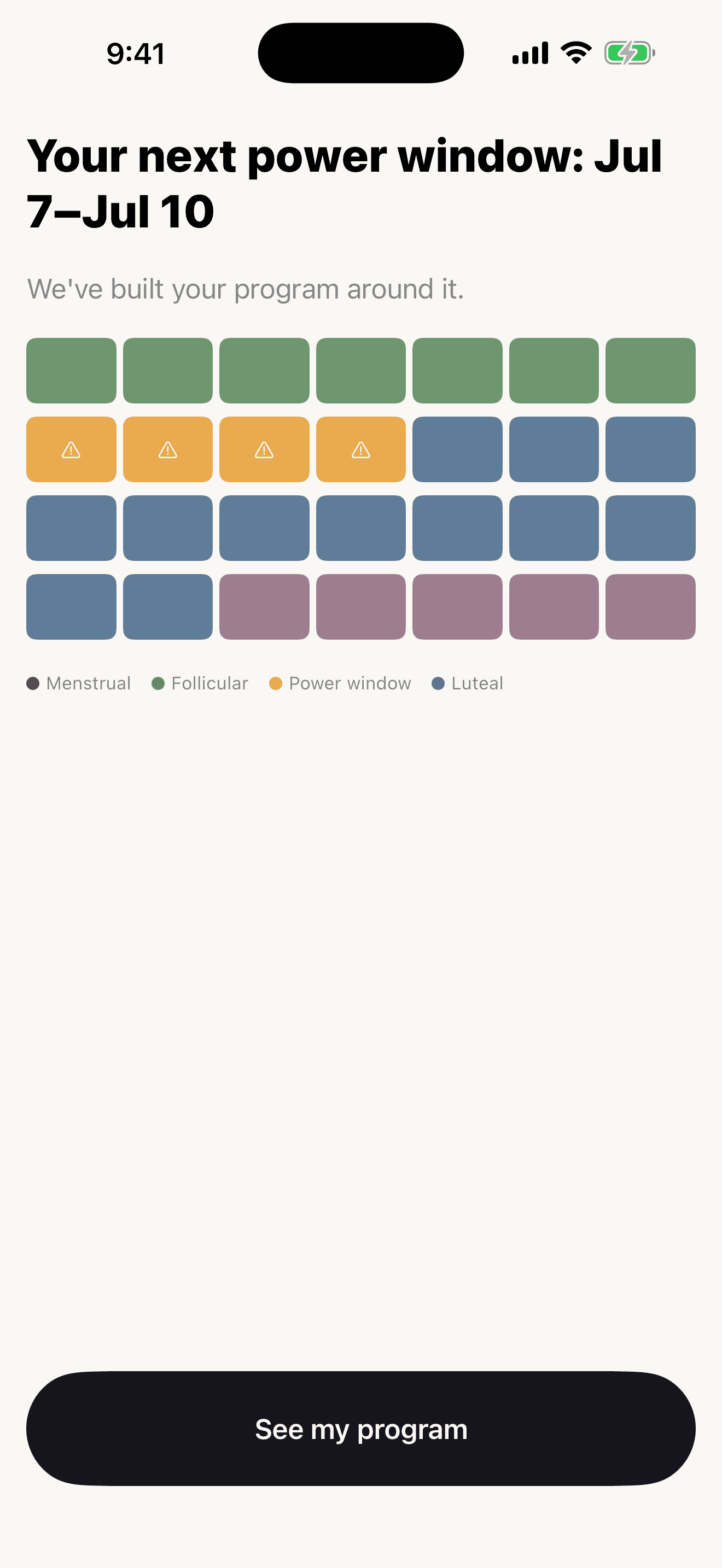
Train with your cycle.
Phase builds this plan for you automatically — a real strength tracker with cycle-aware programming, on iPhone & Apple Watch.
Meet Phase →Phase provides general training education, not medical advice. Cycle responses vary widely between individuals; consult a healthcare provider for medical concerns. Cycle estimates are for training planning only — never for contraception or family planning.