Follicular Phase Workouts: How to Use Your Best Training Weeks
By the Phase team · · 8 min read
Short answer
Use them for progression, not for a different program. The follicular phase — day one of your period through ovulation — is where most lifters report the lowest symptom load, so it is the easiest place to add load or reps and complete full sessions. The advantage comes from the work you actually finish, not from the hormones.
Ask a room of lifters when they feel best and a lot of hands go up for "the week or two after my period starts." That is the follicular phase, and it is worth using well — as long as you are clear about why it feels good, because the popular explanation and the real one lead to different training decisions.
What is happening
The follicular phase begins on day one of bleeding and ends at ovulation. Estrogen rises through it and peaks just before ovulation. It is also the part of the cycle whose length varies most — when your cycles run long or short, this is usually the section doing the varying, while the luteal phase stays near 12–14 days.
The popular story is that rising estrogen makes you stronger. The honest version is narrower. A meta-analysis of 78 studies found only trivial average differences between phases, and its single largest contrast was between the early and latefollicular phase — in other words, mostly the difference between "on your period" and "a week later." Much of that gap is symptom relief, not a hormonal performance boost.
Which is good news, practically speaking: it means your best weeks are driven by things you can influence — sleep, food, symptom management — rather than by a hormone you cannot.
How to structure a follicular build block
Two to three weeks is roughly the length of the follicular phase, which happens to be the length of a sensible build block. Keep the same lifts all the way through and let the load do the moving.
| Stretch | Focus | Practical rule |
|---|---|---|
| Days 1–5 (period) | Re-entry | Train as normal if you feel able; drop conditioning before you drop the main lift — see lifting on your period |
| Days 6–11 | Build | Add load or reps every session where the previous one hit the top of its rep range at or below target RPE |
| Days 12–15 (late follicular → ovulation) | Express | Best window for a heavy top set or PR attempt if the warm-ups are flying; extend the warm-up before heavy knee-dominant work |
The progression rule that does the work
Feeling good is not progress. Writing down a bigger number is. Use double progression, which turns "I felt strong" into something your logbook can verify:
- Pick a rep range for each lift — say 5–8 for a main lift, 8–12 for accessories.
- Keep the weight constant and add reps session to session until you hit the top of the range on all sets, at or below your target RPE.
- Then add weight — roughly 2.5 kg (5 lb) on upper-body lifts and 5 kg (10 lb) on lower-body lifts — and drop back to the bottom of the rep range.
- Repeat. That is the whole engine.
Do this consistently through your best weeks and you will carry a heavier baseline into your harder ones. That is what makes a good follicular phase valuable — not a two-week hormonal window, but a permanently higher starting point.
The handoff at ovulation
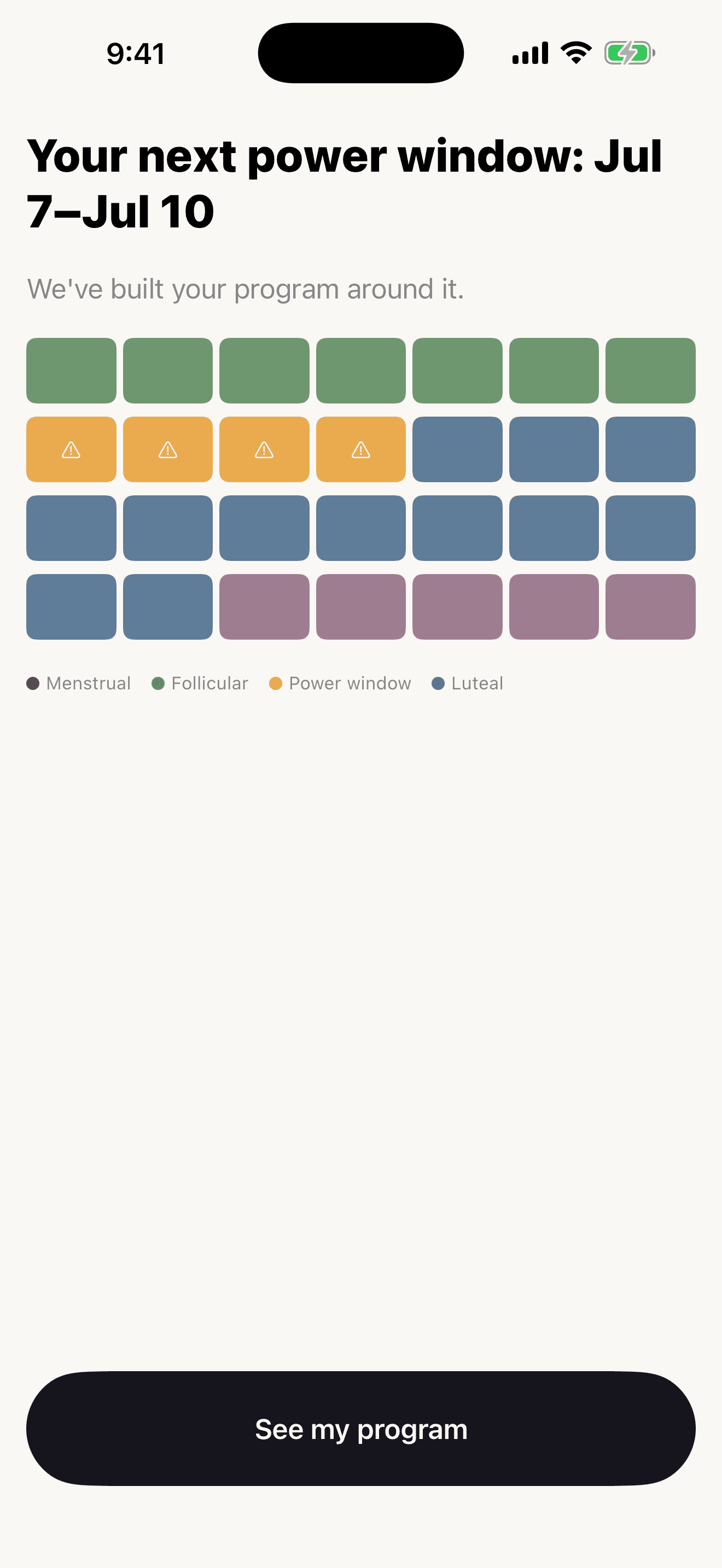
The late-follicular and ovulatory days are where a lot of lifters find their best sessions cluster — the stretch we call a power window. Two honest notes about it:
- It is a personal pattern, not a physical law. Some people see a clear cluster in their own data; some see nothing. Both results are normal, and only your logbook can tell you which you are.
- The laxity caution is worth taking anyway. Some research links the high-estrogen preovulatory stretch with greater knee laxity and higher ACL injury rates — one study of recreational skiers reported roughly three times the odds of injury preovulatory versus postovulatory. But a 2023 systematic review of the biomechanical evidence rated it low-to-very-low quality and inconclusive. The sensible response to genuinely uncertain evidence with a cheap hedge: add five minutes of warm-up and skip max-effort plyometrics before heavy squats. Push hard — prepared.
What not to do with a good week
- Do not add a fourth or fifth session you cannot sustain all month. Volume you only do in your good weeks is volume your body never adapts to.
- Do not chase a PR every session. Maximal attempts cost recovery. One heavy expression per lift per block is plenty.
- Do not change exercises just because you feel capable of more. Progression needs the same movement, measured the same way.
- Do not plan to write off the second half of the month. Muscle protein synthesis after lifting is the same in both halves — the luteal phase guide covers how to keep training through it.
How Phase runs your build weeks
Phase handles the bookkeeping: it runs double progression automatically from your logged sets, tells you when a lift has earned its increment, flags PR-eligible days in your late-follicular and ovulatory stretch, and adds the extended warm-up prompt before heavy knee-dominant work in the laxity window. Every session is stamped with the phase it happened in, so after three cycles your estimated-1RM chart shows whether your best weeks really are where you think they are.
Frequently asked
What is the follicular phase?+
The follicular phase starts on day one of your period and runs until ovulation — usually about 14 days in a 28-day cycle, though this is the part of the cycle that varies most between people and between months. Estrogen rises across it and peaks just before ovulation.
Should I train harder in my follicular phase?+
Train progressively, which is not quite the same thing. Adding load or reps every week is what drives strength, and the follicular phase is a convenient place to schedule that progression because symptom load is usually lowest. But the gains come from the progression, not from the phase.
Is the follicular phase really the best time to build muscle?+
No — a 2025 study in The Journal of Physiology measured muscle protein synthesis after resistance exercise and found no difference between the follicular and luteal phases. What is often better in the follicular phase is how you feel, which affects how much quality work you actually complete.
When should I attempt a personal record?+
On a day when you are well-slept, well-fed, and your warm-up weights are moving fast — those three beat any calendar. Many lifters find those days cluster in the late-follicular and ovulatory stretch, which is why it is worth logging: you are looking for your own pattern, not a universal one.
Do I need a longer warm-up around ovulation?+
It is a cheap hedge. Estrogen peaks around ovulation and some research associates that with increased knee laxity and ACL injury risk, though systematic reviews rate the evidence low quality and inconclusive. An extra five minutes of warm-up before heavy squats costs you nothing either way.
Sources
- [1] Colenso-Semple et al. (2025). Menstrual cycle phase does not influence muscle protein synthesis or whole-body myofibrillar proteolysis in response to resistance exercise. The Journal of Physiology.
- [2] McNulty et al. (2020). The Effects of Menstrual Cycle Phase on Exercise Performance in Eumenorrheic Women: A Systematic Review and Meta-Analysis. Sports Medicine, 50(10), 1813–1827.
- [3] Herzberg et al. (2017). The Effect of Menstrual Cycle and Contraceptives on ACL Injuries and Laxity: A Systematic Review and Meta-analysis. Orthopaedic Journal of Sports Medicine.
- [4] Effects of the menstrual cycle phase on ACL neuromuscular and biomechanical injury risk surrogates: a systematic review (2023). PLOS ONE.
Keep reading
- The science · 5 min readWhat Is a Power Window? Your Cycle's Strongest Days, Explained
- Training guide · 9 min readLuteal Phase Workouts: How to Train When Everything Feels Heavier
- The evidence · 10 min readDoes Cycle Syncing Actually Work? What 78 Studies Say
- Training guide · 9 min readCycle Syncing Workout Plan: How to Train in Every Phase (4-Week Template)
Train with your cycle.
Phase builds this plan for you automatically — a real strength tracker with cycle-aware programming, on iPhone & Apple Watch.
Meet Phase →Phase provides general training education, not medical advice. Cycle responses vary widely between individuals; consult a healthcare provider for medical concerns. Cycle estimates are for training planning only — never for contraception or family planning.