Why Am I Weaker Before My Period? (And Why You Probably Aren’t)
By the Phase team · · 8 min read
Short answer
You are probably not weaker — the same work has become more expensive. After ovulation your core temperature runs about 0.3–0.5 °C higher, sleep is more often disrupted, and premenstrual symptoms are reported by roughly 78% of athletes. All of that raises perceived effort at an unchanged weight, while measured maximal strength barely moves.
It is one of the most common questions in women’s strength training, and the standard answer — "your hormones make you weaker" — is both vague and largely wrong. The interesting version is more specific: your output is roughly the same, but the cost of producing it went up. Those are very different problems with very different fixes.
What the numbers say
The largest synthesis on this question — a systematic review and network meta-analysis of 78 studies, published in Sports Medicine in 2020 — found only a trivial average difference in exercise performance across cycle phases (pooled effect size −0.06). A 2025 tracer study in The Journal of Physiology then found no difference in muscle protein synthesis after resistance exercise between the follicular and luteal phases at all.
So on average, the bar is not heavier. That is genuinely good news: the session you are dreading will still build the same muscle it would have built two weeks ago. See the full evidence review for how solid that finding is.
Averages, however, do not lift weights. Individual people do, and the individual experience is well documented too.
The four things that genuinely change
| What you notice | What is likely behind it | What to do about it |
|---|---|---|
| Everything feels 1–2 RPE harder at the same weight | Core temperature ~0.3–0.5 °C higher; in one cycling study heart rate and perceived exertion were both elevated — but only in women with a large progesterone rise | Add 30–60 seconds of rest between top sets; keep the load, buy back the recovery |
| You warm up slower and gas out sooner | Higher starting temperature plus higher sweat rate means less thermal headroom in a hot gym | Longer, easier warm-up; cold water on hand; drop conditioning before you drop the main lift |
| Poor sleep the night before hard sessions | Sleep quality is one of the most commonly reported affected domains in the 1,086-athlete survey | Move the heaviest session to your best-slept day of the week, not to a phase |
| Low motivation, "why bother" feeling | Symptom load and mood — participants in a 2025 qualitative study described reduced training energy and a greater need for recovery | Reduce the decision, not the training: fixed program, show up, cut the session short if it is genuinely bad |
Notice how many of those are logistics, not physiology. A hot gym, a bad night, and a session you have to talk yourself into will cost you more kilos than any hormone will.
The scoreboard trap
Here is the trap that makes premenstrual weeks feel like backsliding: you judge the session by how it felt, and the feeling is the one thing that genuinely changed.
Your actual scoreboard is weight × reps, written down. When lifters log through a rough week and look back afterwards, the usual finding is that the numbers held — sometimes an extra rep, sometimes one fewer, well inside normal noise. The dread was real; the regression was not.
If you only remember one thing: judge the week by your logbook, not by your rating of perceived exertion.
The four dials worth turning
- Rest, first. Longer rest is the cheapest fix in strength training and the one that most directly offsets elevated perceived effort. Take three minutes instead of two before top sets.
- Cap the RPE, not the weight. Stop sets at RPE 8 rather than grinding to failure. You keep the load and the practice, and lose only the fatigue you were not going to recover from anyway.
- Trim volume from the back end. If something has to go, cut the last accessory, not the main lift. A 10% volume reduction is invisible over a training block.
- Fuel the session properly. Under-eating carbohydrate before a heavy session produces exactly the symptoms people attribute to their cycle. Eat, hydrate, add sodium if you sweat heavily.
What is not on that list: switching to yoga, skipping the week, or deloading on the calendar. Those cost real training weeks — the luteal phase guide goes through the trade-offs in detail.
When it is not your cycle
Cycle timing gets blamed for a lot of things it did not do. Consider other explanations when:
- The fatigue is constant, not cyclical. A pattern that does not track your cycle is not caused by your cycle.
- Your periods are very heavy. Heavy menstrual bleeding is a common and treatable cause of low iron, and low iron flattens training capacity all month. Worth raising with a healthcare provider rather than training through.
- Strength is trending down across months. That is a programming, recovery or fuelling problem — a within-month dip and a multi-month decline are different diagnoses.
- Your cycle has become irregular or stopped alongside hard training or weight loss. That warrants medical advice, not a training tweak.
How to find your own pattern
Three cycles of honest logging settles the question for you personally better than any study can. Record weight, reps and an RPE for your main lifts, note the days you felt rough, and then look at your estimated 1RM chart with the phases marked. One of two things will be true: there is a visible dip, or there is not.
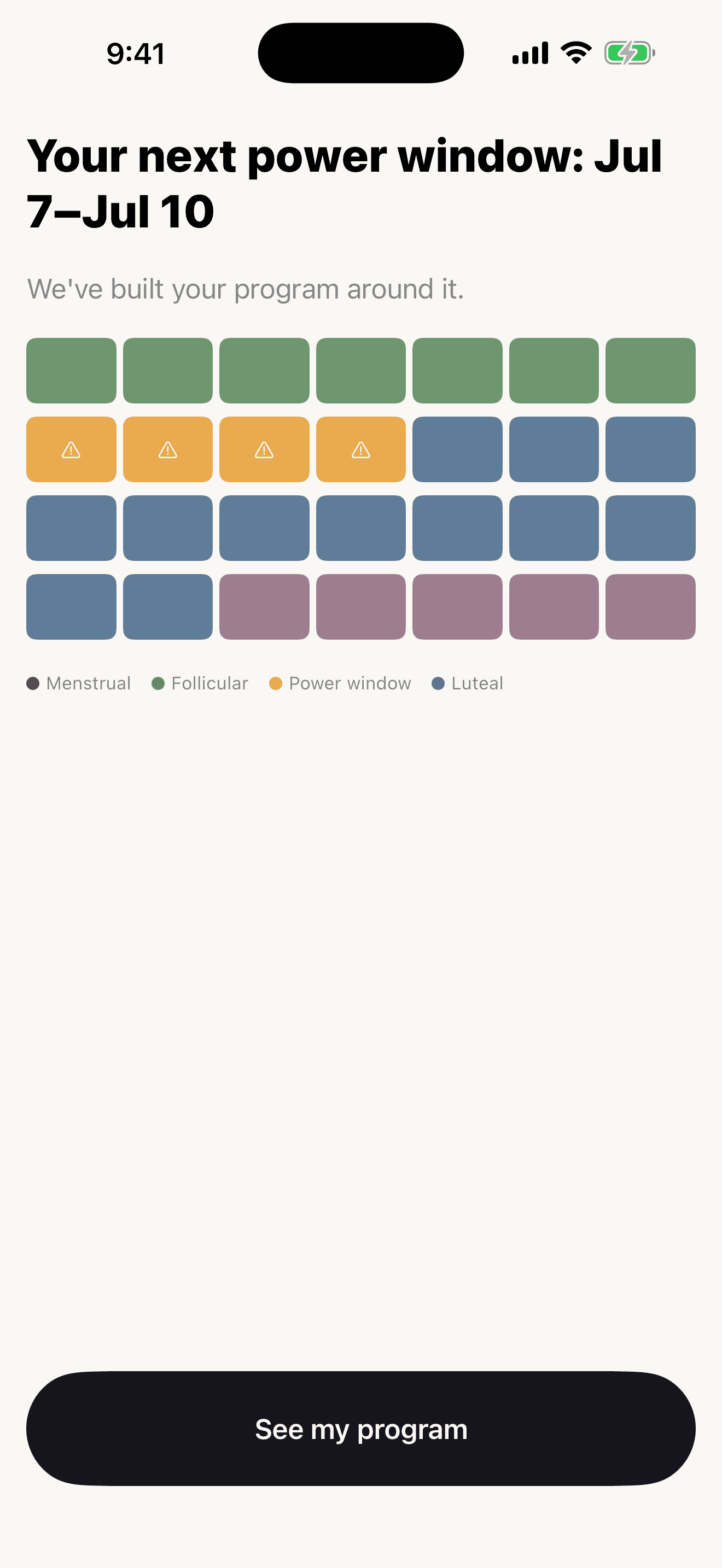
That is precisely what a power window is — not a universal law, but the stretch of your cycle where your numbers cluster highest. Phase does the tagging automatically: every set you log is stamped with the phase you were in, the chart colours itself by phase, and its suggested adjustments shrink toward zero if your logged effort says the textbook does not apply to you.
Frequently asked
Why do I feel weaker the week before my period?+
Mostly because the same work costs more, not because your muscles produce less force. Core temperature runs about 0.3–0.5 °C higher after ovulation, sleep is often more disrupted, and premenstrual symptoms are reported by around 78% of athletes. All three raise perceived effort at an unchanged weight.
Does strength actually drop before your period?+
Measurably, barely. A meta-analysis of 78 studies found only trivial average differences in exercise performance across cycle phases. Individuals vary — some people do have a consistent dip — which is why logging your own lifts is more informative than any general rule.
Should I lower the weight during PMS week?+
Lower it only if the set demands it. Keep the same program and the same lifts, but autoregulate: if your working weight comes in two RPE points harder than usual, drop the load 5–10% or cut a set. Do not pre-emptively deload the whole week on the calendar's say-so.
Is it normal to feel heavier or more bloated when lifting before my period?+
Yes — fluid retention and bloating are among the most commonly reported premenstrual symptoms, and they can add a couple of pounds on the scale and make belted or bracing-heavy lifts feel different. It is not fat gain and it resolves once your period starts.
When is feeling weak not about my cycle?+
If fatigue is constant rather than cyclical, if your periods are very heavy, or if strength is trending down across months rather than within a month, that is worth a conversation with a healthcare provider. Iron status, under-fuelling and chronic sleep debt all cause the same symptom and none of them are fixed by cycle timing.
Sources
- [1] McNulty et al. (2020). The Effects of Menstrual Cycle Phase on Exercise Performance in Eumenorrheic Women: A Systematic Review and Meta-Analysis. Sports Medicine, 50(10), 1813–1827.
- [2] Charkoudian & Stachenfeld (2020). Temperature regulation in women: Effects of the menstrual cycle. Temperature, 7(3).
- [3] Perceived impact of the menstrual cycle and hormonal contraceptives on physical exercise and performance in 1,086 athletes from 57 sports (2022). Frontiers in Physiology, 13, 954760.
- [4] Power in the flow: how menstrual experiences shape women's strength training performance (2025). Frontiers in Sports and Active Living.
Keep reading
Train with your cycle.
Phase builds this plan for you automatically — a real strength tracker with cycle-aware programming, on iPhone & Apple Watch.
Meet Phase →Phase provides general training education, not medical advice. Cycle responses vary widely between individuals; consult a healthcare provider for medical concerns. Cycle estimates are for training planning only — never for contraception or family planning.